Books are a forest and it’s hard to see the trees, except the tall ones or the old ones. But when you enter the forest, it’s the new growth that emits the sunlight....

Tuesday, January 8, 2013

Memory, eidetic memory, and fiction


Memory.  What is it?  Words or is it pictures?  I don’t know if people think about that unless they notice exactly what goes through their heads when they remember.   If a name is mentioned, does a picture of the person flash through the head?   Or a street named in the hometown.  Is it accompanied by a landscape?


Writers probably think about that more than other people.  Pictures in the head inspire a writer to transcribe them or create them.  I liked to describe interiors while I was impressed at the descriptions other writers did with faces.  That was often a struggle for me yet we see many faces in our lifetimes. 


When I began writing fiction, I read a book entitled Creative Visualization, a book written to empower its readers with visualizations that promoted relaxation and might create their futures.  Living in the city, I used to imagine a scene near a water wheel and walking between apple blossoms to meet a guide I called Z in the countryside.


Verner Moore White  from Wikipedia


Dr. Andrew Weil made a similar suggestion at his site.  His was based upon memory and the calling up of past places.

Young photo of Dr. Weil


Simple Steps to Reduce Your Stress: Imagery - from Dr. Weil's site
Using imagery to relax is a terrific way to reduce stress and work through those day-to-day challenges. It's simple, low-tech and effective: all you need is your imagination and a few minutes to yourself. Begin by closing your eyes and taking deep, measured breaths. Imagine that you are in beautiful surroundings - either someplace you have visited or someplace you conjure up from your imagination. Focus on bringing all the elements of the scene to life: the colors you see, the sounds you hear, the smells you detect. Bring the images into focus and try to "stay in" the scene for at least five minutes. Practice this exercise for a few minutes every day or use it whenever you're stressed.


Writing fiction, I often concentrated on a neighborhood or a place.  Somehow my present place was blinded out and the picture brought about a kind of escape.  It became a game.  I would remember the “little store” in my childhood neighborhood and the house of a friend beyond it.  The game was to see if I could recall the houses in-between them.  I could imagine myself walking along the sidewalk and sometimes I would see more, other times I would be in a gap.


John Gardner wrote that fiction, at its best, keeps the reader in a trance-like state.  He maintained that the writer could induce for themselves a trance.  The better the trance in writing, the less the reader would fall out of the story. 


I used to do an exercise from John Gardner’s book  On Becoming a Novelist.  This exercise done early in the morning usually erased the tensions about the coming day and brought me to the next page of my work-in-progress.


A simple method is to sit in a chair with comfortable arms – preferably in a fairly dark, quiet room -  your arms flat on the arms of the chair, and tell yourself with firm conviction  ( it will prove justified)  that although you will not move a muscle, your hand and forearm are going to rise.  Concentrate on not moving the arm, but without resisting whatever may begin to happen to that arm, and concentrate too, on the belief that the arm will rise.  You will soon begin to feel an odd lightness in the hand, and eventually, independent of conscious volition, the arm will lift.  Magic.  … In this light hypnotic trance, make to yourself positive (never negative) suggestions - from On Becoming a Novelist by John Gardner


I wondered if fiction writers had eidetic or photographic memories.  Here on the internet, I found some tests for that. 


This site has pictures that must be recalled as puzzle pieces.

http://www.mentesenblanco-razonamientoabstracto.com/test-memoria-fotografica-en.html


Well, if these aren’t as interesting as computer games, such sessions are also designed to improve memory.


I took the tests and, although I did better on one than another, better with landscapes than with cartoon figures, I didn’t have what is termed an eidetic memory.  Eidetic memories are perfect, like a camera snapshot apparently, and there is controversy about whether the ability is valid.


“The vast majority of the people who have been identified as possessing eidetic imagery are children._ - Scientific America   


Slate Magazine discusses eidetic memory:   “This seems like as good an opportunity as any to clear up the greatest enduring myth about human memory. Lots of people claim to have a photographic memory, but nobody actually does.”   Following this assertion were details about contested research.  


Yet there is a list of people claimed to have eidetic memory on Wikipedia.  Included are Adolph Hitler, Bill Clinton, Swami Vivekananda, Hans von Bulow, Nicola Tesla, Abbie Hoffman, Mozart, Theodore Roosevelt, and one author, Ray Bradbury.


I would think more authors would be cited only because it seems many have proof of photographic memories.  But the point is, memory is selective.  If writers and other people have memories that are in pictures, they are probably likely to remember what they want to remember.  So the pictures are there but with memory gaps.  Perhaps that stimulates the creative energies.  The memory provides a real backdrop or template and then the creative picture is one that becomes filled in with this stuff called fiction. 


People wonder how writers get started.  I usually state that I began writing about a subject when it was gone.  My first essays, taped to our kitchen wall, were about a cat that ran away and about a yard plum tree that was scorched and destroyed by lightening.  They were gone but the pictures of them weren’t.  The cat and plum tree became writing material.


Creative energy is mysterious and still a subject of inquiry and research.  Probably because it is an individual experience and differs from one person to the next.  When I was a newspaper reporter in a St. Paul suburb, I interviewed a playwright of historical plays, Lance Belville.  I asked him how he wrote his plays and he said he didn’t really know.  When they were finished, he had trouble recalling how exactly they were constructed. 


That was puzzling before I wrote long fiction.  But a few years after writing a manuscript, I would have trouble remembering how the story congealed.  What do I remember?  I remember moments at the typewriter, the typewriter or computer itself, what was in that setting, and events in my life at the time.  But I have trouble recalling how I arrived at the story plot.  Are authors in a kind of trance or do they go about things in a more orderly way?


Sunday, December 9, 2012

First editions, First tries


First editions are first tries, both for the author and the publisher.  Their worth in the used and rare book field is often something to wonder about when you consider that the first edition of Gone with the Wind looks like the umpteenth printing.  Fine bindings and good condition can’t help but hold sway.  Yet the esteem for courage, that of an author or a publisher, is what makes a first edition a prize for the book collector.


Last summer, I found a collectible Saturday Evening Post, the March 31, 1945, issue containing J. D. Salinger’s short story “A Boy in France" besides having a Norman Rockwell cover.  Beyond the enjoyment of paging through old magazines, I occasionally have the delight of finding the valuable one – usually after I’ve brought it home.  My biggest thrill was finding early Dr. Seuss adult cartoons in a Judge magazine.  I’d attended the huge sale of a book dealer closing his store, thousands of books, magazines, and prints.  He laughed as hard as I laughed at the cartoons, finding out that I’d unknowingly found that magazine.  Click here to look at early Seuss political cartoons.


Back to J. D. Salinger.  The 1945 magazine reminded of my first rare book sale, a book I bought without thinking of its worth.  J. D. Salinger self-published in 1940.  He wasn’t very well known at that time and decided to publish a collection of short stories before he became published in national magazines like the Saturday Evening Post.


Before working at a used book and antiques store, I browsed at the paperback exchange shop in Duluth, Amazing Alonzo’s, a store with an eclectic stock.  I was exchanging books for something new to read.  In the fiction section, I found an odd paperback that looked like a literary journal.  But this was headlined with J. D. Salinger’s name.  In the 1960s, I read J. D. Salinger books and especially liked Franny and Zooey.  The obscure short story collection from a known author was just what I wanted that day because I was working on short stories.  It looked like this:


I took this paperback or literary publication to work and read it during lunch.  Then it disappeared into a pile of magazines and literary journals, kept in a magazine holder.  After I began working with used books and started my own collection, I cleaned out the toppling magazine holder.  At the very bottom was the 1940 Salinger paperback.  I looked inside it, curious after having some advice at my new job, and couldn’t find any publisher.


The paperback I almost threw out with the magazines was rare.  Early works of well-known authors, often published in the worst wraps, are probably worth more than the first edition of their second well-received book.  The advice is, if you find an unfamiliar title by a well-known author, be sure to hold onto it.  The selling failures of a famous author might be very valuable.


That’s a cheerful note for anyone who feels that their best work hasn’t been published yet.  On the second day (half price) of an estate sale, I found a book of Mario Puzo’s that wasn’t noticed by anyone attending the sale, a children’s novel called The Runaway Summer of Davie Shaw.  It was his first book, a story about a California boy running off with his pony to New York.  I liked what I read but Puzo was an unknown author then, a journalist, and writing while his children were growing up.  After that, he wrote The Godfather.  


Used book dealers look for these lost books and also those that are not confidently distributed by publishers.  I picked up a dilapidated copy of Slaughterhouse Five, a first edition.  But that probably didn’t mean anything, being published in the 1960s. Yet this first edition was valuable!  Vonnegut’s first novel was so strange that the publisher didn’t print very many copies at first.  What I had was very rare.  The strangest thing of all was that it was used from an Air Force base library and the book was defaced with those markings.  Perhaps those markings added to its worth. 


To wind up here, I want to announce that I’m stuck with four copies of my “first edition” of The House in Windward Leaves.   

I’ve re-published the book with a Bradley Wind cover (at the upper righthand column) and illustrations inside.  (The main character Sadie looks into her crystal ball at left.)


 If anyone would like to read the middle grade comic fantasy for the story itself and especially for review, simply contact me and I’ll send you the first paperback.


While I was re-publishing that book, I signed a contract for The Swan Bonnet with GMTA (Great Minds Think Aloud) Publishing.  The Swan Bonnet was my Authonomy.com gold medal, reaching the HarperCollins Editor’s Desk.

Thursday, November 8, 2012

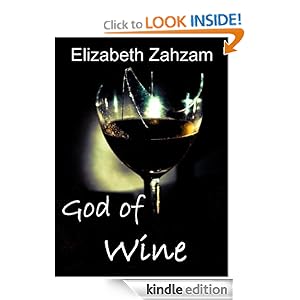
Storyteller or dramatic narrator? With a review of Elizabeth Zahzam's God of Wine


Some experiences challenge accepted ideas.  In the last days, we’ve seen the entire east coast region in a black out, cut off from transportation and even communication.  Yet this vulnerability hasn’t brought on any foreign attack.  The U.S. still has so much to offer other nations that its presence is probably too vital for any planned attack.  I grew up during the Cold War era and since then, our defense system may have operated on a foundation of paranoia.  I was glad to hear of the National Guard helping during this crisis.  I did wonder, thinking about the millions without power and many without their normal housing, why more of our readied forces couldn’t have made certain that citizens weren’t in danger or experiencing severe suffering. 

I’m sure many stories will come out of this.  And even if they are now being told verbally, would you hear it from a storyteller or from a person who might dramatize or act out their experience?

A few weeks ago, I finished Elizabeth Zahzam’s God of Wine.  The author works through scenes about theater people in New York City while intriguing the reader with active interior from the protagonist.  Elizabeth is from Superior, Wisconsin, across Lake Superior from Duluth where I live.  For many years, she has lived in New York and recently, endured the storm waters and wind there. 

God of Wine is a fascinating book and I would say a dramatic narrative.  Here is my Amazon review:

An intoxicating book, the story of Krissy is about her development as well as about the adulations of the theater. Krissy makes you cringe sometimes, wanting the Broadway actor Taylor and accepting the plan of the eerie theater man, Dionysus, in breaking up Taylor's marriage.  Dionysus is an enthrallment, directing a plan she won't accept as her own. It involves scandal and a twisted plot in causing Taylor, a recovering alcoholic, to become inundated with Krissy.

I really liked how Dionysus was both real in being an older man hanging around the theater and symbolic in directing Krissy before she finds an agent.  Sometimes he seems real and other times, he hauntingly appears as the motivator, critic, and tempter.  This made me wonder about Krissy besides
Taylor, whether she gives Dionysus a delusional power, accepting her role rather than taking responsibility.  In the same way, his protégée Taylor can't take responsibility once he is drunk.

The book is written with both dramatic terseness and interior rapture, driving the story so that I knew I would read it to the end. Elizabeth Zahzam is skilled and she has depicted a scenario that punctuates with possible reality while Dionysus's ability to turn up adds speculation and the highs of hoped-for love. The book has the illusion of theater and it takes on the challenge of the tragic.


After congregating with other book writers on the Internet, I wondered about the writing advice of our time:  “Don’t tell, render the scene”;  “Start in the middle of things”;  “Show, don’t tell.”   Often I commented on what I preferred, a balance between narrative and rendered writing.  Even today, narrative writing can be mesmerizing while rendered writing conveys the vitality of characters.

Authors of early novels, using the omniscient narrator, told about their characters, around them, and they could even psychoanalyze them.  They also wrote blocks of description.  A favorite novel of mine, Far From the Madding Crowd by Thomas Hardy begins:  “Description of Farmer Oak – An Incident    When Farmer Oak smiled, the corners of his mouth spread till they were within an unimportant distance from his ears ….His Christian name was Gabriel…”   There are seven paragraphs of narration before Hardy renders the protagonist’s new beginning after her inheritance.  Agreeing with me, Amazon readers today gave the book 4.5 stars. 

And then there was Dickens’s beginning at the beginning of things.  “I am born,” tells David Copperfield.

Film probably threatened the novel from the first.  I’ve thought that the book writer should try to accomplish what the film can’t.  There aren’t many films that are told by a master narrator.  And it’s difficult for film to account for a character’s inner feelings and schemes. 

From http://ansnuclearcafe.org
There seems to be two kinds of narrative – storytelling and dramatic.  From ancient times, the storyteller narrated as in The Bible, Homer, and the Indian sagas.  Then the Greeks introduced written drama.  After that, dramatic writing often paralleled narrative writing, in Rome, England, and France. 

From Wikipedia
We were told to render everything.  When I began long fiction, it came naturally to write the juvenile novel, probably because I read many of them in grade school.  I wasn’t so much of a storyteller, I knew.  I liked to jump into the action and bring on the dialogue.  Later, I felt that I needed to fill in gaps between scenes and strengthen my narrative voice.

Especially since I’d noticed that readers in the 1980s and 1990s liked strong narration.  Joyce Carol Oates, Margaret Atwood, and Ann Beattie all have distinctive narrative voices.  In saying that, I mean that the voice lends tone and mood to the writing while a more dramatic narrator seems to be observing or reporting the story.

Doris Lessing’s narrative in her Children of Violence series was so luscious between the strong scenes that I read every book.  The first, Martha Quest, begins:  “Two elderly women sat knitting on that part of the verandah which was screened from the sun by a golden shower creeper….”   In the next 12 paragraphs, the author tells about Martha’s father and mother, English settlers in Africa, and about Martha.

Alice Adams is a dramatic writer, I think.  Superior Women starts:  “All, or almost all, of the events of Megan Greene’s life, its violent dislocations, geographic and otherwise, are set in motion in the instant in which she first sees a young man named George Wharton… This takes place in the Stanford Bookstore, where Megan has a summer job ...”  After this, there is much dialogue in scenes that are spaced from one another.

Whatever works seems the creed of most writers.  Understanding one’s stronger or more natural way of telling a story might be the way to begin.  I’ve spent two years rewriting and editing my manuscripts.  I wonder how I might begin again.

Monday, October 15, 2012

Blog Hop


The following is a list of questions in a Tag Game for Writers sent to me by writer friend, Janie Wilder Bill.  At her blog, she tells about her Work in Progress, Under a Full Moon, a young adult mystery centering on a crime committed near a lagoon. 


Because Halloween is coming, I am answering about my middle grade Halloween fantasy.


What is the working title of your book?

The House in Windward Leaves

Where did the idea come from for the book?

The House in Windward Leaves began as a short story that I wrote for a Halloween storytelling at The Loft literary center in Minneapolis.  A block away from where I lived in Minneapolis was a brick house whose walls and windows were streaming with leaves, stunning in the fall.  Apparently, the owners liked looking at the leaves outside their windows, if anyone lived there.  My idea began with the question “What do you want to be when you grow up?”, a question that is so speculative that it might be best if kids could somehow try out their ideas.  In the book, the children are enchanted to a star community where costumes make the kids.

What genre does your book fall under?

Middle grade fantasy.

Which actors would you choose to play your characters in a movie rendition?

If this were to be filmed, I see it as animation first.  But it could be filmed with actors and that might make it more amusing.  I see Mistral the Enchanter part as an older actor, not very tall, and capable of doing the eccentric character, maybe a Richard Dreyfuss type or possibly a Robin Williams.  Ideally, it would be a small man.  I’m not sure about the child parts except that I think they should be children.  Riff Raff the thief - Jim Carrey? – but he might be too tall for the other characters.  Matilda is orange-haired and cat-like.

What is the one-sentence synopsis of your book?

The wayward Sadie leads her friends into an enchantment where their Halloween costumes become real.

Will your book be self-published or represented by an agency?

The House inWindward Leaves is my first published book, the only one self-published so far.   At this time, I am considering another printing with illustrations.

How long did it take you to write the first draft of your manuscript?

This took some months, probably six to eight months.  Actually, I wrote it many years ago and then rewrote it in the last few years.

What other books would you compare this story to within your genre?

Beyond its being a fantasy, The House in Windward Leaves is a satire or comedy.  I would say it came from the inspiration of Roald Dahl and that it has identity issues that appear in the Narnia books by C. S. Lewis.  The characters feel they must fulfill a role, and that causes conflict with their sense of identity.

Who or what inspired you to write this book?

I always loved Halloween and especially Halloween parties.  Yet before I ever blocked in writing, I used to block at the choice of a Halloween costume.  I wanted to do something creative but once in that costume, it seemed to affect the entire evening, especially at college and adult parties. 

I was never much for acting but I spent time in the orchestra pit, playing flute and piccolo for musical theatre in high school, college, and in the Twin Cities.  It was remarkable to me that actors could live these roles in their costumes.  

The House in Windward Leaves has more moments of humor than horror while the horror on Mistral the Enchanter’s  star is its static state.  What would happen if you were stuck in your costume? That's a horror adults know.  After all, aren't our fantasy identities a part of us?  The idea is that our fantasies really do affect our futures.

What else about your book might pique the reader's interest?

As mentioned before, this book is set up a little like Charlie and the Chocolate Factory and the Narnia books.  There are six main child characters, and because each of them is different, one’s adventures might be an identification point during the enchantment. 

Sadie is impatient about the future so she dresses as a Fortuneteller.  Gretchen doesn’t care about her costume and, because her nun’s snood is lost, goes trick or treating as a Priest.  Roger is political, Ben wants to toot his trumpet in the neighborhood, Tim is athletic and would like to run as fast as a zebra, and Candy really wants to be Homecoming Queen someday.  Other characters of Halloween magic are in the enchanted community along with the thief Riff Raff who instigates a treasure hunt for the necklace he stole.  This hunt becomes madcap as many of the enchanted characters would rather have the prize of a new wish rather than maintain their costume identities.


I now tag the following world-great writer pals!


Elizabeth Marcus


John Campbell

Gerry McCullough

John Booth

Catherine Condie


Sunday, September 30, 2012

Learning new words or old words?


Drama queen.  Decandy.  Podsnap.  Geophony.  Two words are new; two are old.  They all seem like words I might have used for my middle grade fantasy, The House in Windward Leaves.  Because its action happens on a star, I made up a few words there.  If your kids are impatient for Halloween, it might ready them.  The wayward Sadie leads her friends into an enchantment where their Halloween costumes become real.

Words.  I began reading before grade school and still believe that the best way for learning is to begin with fascinating subject matter (like Peter Rabbit).  Learning words will happen as they appear in context and are encountered again.  Somehow I accepted the words implored and exert only because Beatrix Potter used them for her picture book.
There are so many new words appearing in the English language that we learn as they come.  I was waiting for an appointment, reading People magazine, when I encountered the word sexting.  Whatever it was, I began to understand it from the context.  I guess its definition might be "suggestive texting." 
From The Jesuit Post
The English language is often accused of having the most words of any language in the world.  Even this year’s new dictionary words warn us that the English language is expanding like the universe.  I knew a few of the new words, could guess some, and would have to look up others.


In the Webster Merriam, supersize probably refers to photo programs, drama queen was a word I’d heard, sandwich generation was one I was learning.    


What was more curious were the new additions to the Oxford English Dictionary, terms that were American to me:  Kennedyesque, Scotchgarding, superbabe, cybercast, and urbanscape.  You have to wonder if these terms will be used in future decades, and if they will be looked up.

Even more cryptic to people who are not up on things and probably very cryptic to future readers are new words in the Cambridge Dictionary:  applepick –  to steal someone’s iPhone; twittion – a Twitter petition; geophony – combined sounds of the natural world.

When computers were first introduced, the word menu irritated me.  That word only referred to restaurants then, and when I saw it on a computer, I imagined the guys thinking about lunch.  It didn’t do much for my stomach because the "menu" was about files. 

When the alternative to aspirin was ibuprofen, I refused to buy it, mostly because I couldn’t pronounce or spell the term as easily as people who were in-the-know.  In The House in Windward Leaves, words are made up in the Halloween land because a doctor and nurse, transformed there, needed to name the conditions of a patient who was enchanted into continually being a patient. 

If a reader doesn’t mind learning new words or their context, they might not mind college English courses.  Many complain that past literature is unreadable because of the outdated words and style.  As a used book dealer, I know there are still people out there who are comfortable about plowing through obsolete styles and words as much as with-it readers are eager to learn newly invented words. 

Shakespeare’s picturesque word decandy (melt away) might have been a dandy word in my Halloween fantasy.  I remember liking his word dissemble because it somehow made visual the meaning of faking.


“I let my flankers on both wings spread to the right and left, and make what dust they could….”  - The Travels of Baron von MunchausenFlankers sounds like something on my Windward Leaves enchanted planet.  But the word tells about Baron von Munchausen, from a book that I soon learned to watch for in 19th century editions.  People collect it for its fabulous content and because it was a good Twentieth century movie.

Footpads is another word that might seem contemporary.  And it would fit the villain of The House in Windward Leaves with its definition, “thieves who rob pedestrians.”  Edgar Allen Poe used it.  Podsnap might be mistaken for a newly invented word but it is Charles Dickens’s, meaning “a person having an attitude marked by complacency and the willful ignoring of unpleasant facts.”  

Women are reading Jane Austen again which means that they are willing to digest words like auspicate.  Having re-read Jane Eyre recently, I can appreciate why people avoid Charlotte Bronte’s style and words such as animadversion.  Still, I recently had to crane my brain at “new tricks” words such as analog VGA inputs when shopping for a new computer monitor. 

Do you yay or nay new words?  Who makes them up?   Which words in old books should we eliminate and replace in digital editions?   I felt strongly about some of these unusual words and I wonder if word use isn’t a natural democratic process.


GIVEAWAY at GOODREADS of  Curiosity Killed the Sphinx and Other Stories published by Hollywood Books International  ENTER  from October 5 through November 5  HERE


Friday, September 7, 2012

Representative Akin and graduate school in a high crime area

At first I dismissed Representative Todd Akin‘s weak statement about rape and conception as more political cant like that about abortion.  Another statement about women that sidetracked the real issue of violence in our society.  The candidate had supplied no statistics and yet he gained international attention.

Just a month before, I looked up the statistics of violence against women in Minnesota, thinking of a move.  I had been told that the crime rate was better in Minneapolis.  In 2009, Duluth boasted a zero rate of rape while the rate in Minneapolis was about five times per capita that in New York City.  I lived in South Minneapolis in the 1980s while attending graduate school and, although many women were from outstate Minnesota (towns or small cities), we didn’t know how quickly the crime was rising.

According to this chart, rape and assault increased 20 times in Minnesota from 1960 to 1995.  


Minnesota Crime Rates 1960 - 2010


Forcible

Aggravated


Year
Population
Index
Violent
Property
Murder
Rape
Robbery
assault
Burglary


1960
3,413,864
50,049
1,435
48,614
42
81
950
362
12,645


1961
3,470,000
50,370
1,505
48,865
34
94
951
426
13,225


1962
3,475,000
53,762
1,674
52,088
33
124
1,028
489
13,312


1963
3,500,000
59,392
1,983
57,409
41
91
1,186
665
14,160


1964
3,521,000
70,398
2,601
67,797
51
157
1,285
1,108
18,833


1965
3,554,000
71,485
3,074
68,411
50
186
1,433
1,405
18,853


1966
3,576,000
79,893
3,691
76,202
79
261
1,765
1,586
20,713


1967
3,582,000
92,887
4,727
88,160
58
309
2,402
1,958
25,233


1968
3,646,000
108,041
5,111
102,930
81
398
2,959
1,673
29,232


1969
3,700,000
113,836
5,253
108,583
69
424
3,016
1,744
28,836


1970
3,805,069
121,796
5,782
116,014
75
369
3,389
1,949
30,507


1971
3,881,000
137,267
5,993
131,274
95
468
2,987
2,443
34,219


1972
3,896,000
130,674
6,798
123,876
95
571
3,290
2,842
36,124


1973
3,897,000
137,781
6,926
130,855
107
579
3,455
2,785
39,610


1974
3,917,000
153,976
8,119
145,857
118
692
4,079
3,230
43,939


1975
3,926,000
168,766
8,125
160,641
129
730
4,069
3,197
46,842


1976
3,965,000
171,727
7,492
164,235
92
726
3,189
3,485
44,493


1977
3,975,000
168,176
7,705
160,471
106
774
3,413
3,412
45,103


1978
4,008,000
166,096
7,601
158,495
81
797
3,411
3,312
43,837


1979
4,060,000
178,349
8,973
169,376
93
871
3,754
4,255
45,183


1980
4,061,235
194,918
9,250
185,668
106
942
4,025
4,177
50,602


1981
4,090,000
193,731
9,344
184,387
85
1,056
4,266
3,937
52,253


1982
4,133,000
184,110
9,062
175,048
95
938
4,188
3,841
48,855


1983
4,144,000
167,177
7,909
159,268
69
927
3,298
3,615
44,571


1984
4,162,000
159,884
8,802
151,082
74
1,051
2,960
4,717
41,242


1985
4,193,000
173,348
10,751
162,597
88
1,242
3,598
5,823
42,663


1986
4,214,000
183,823
11,991
171,832
105
1,338
4,299
6,249
42,319


1987
4,246,000
195,986
12,118
183,868
112
1,439
4,354
6,213
45,384


1988
4,306,000
185,792
12,490
173,302
124
1,337
4,079
6,950
39,167


1989
4,353,000
190,801
12,549
178,252
111
1,363
4,128
6,947
39,042


1990
4,375,099
198,577
13,392
185,185
117
1,487
4,057
7,731
39,691


1991
4,432,000
199,274
14,006
185,268
131
1,762
4,345
7,768
37,832


1992
4,480,000
205,664
15,144
190,520
150
1,840
4,906
8,248
39,859


*1993
4,517,000
198,125
14,778
183,347
155
1,588
5,092
7,943
38,147


1994
4,567,000
198,253
16,397
181,856
147
2,725
5,370
8,155
36,157


1995
4,610,000
207,327
16,416
190,911
182
2,593
5,702
7,939
36,756


1996 
4,658,000 
207,891 
15,782 
192,109 
167 
2,327 
5,385 
7,903 
35,515 


1997 
4,686,000 
206,833 
15,827 
191,006 
129 
2,446 
5,373 
7,879 
35,265 


1998 
4,725,000 
191,197 
14,656 
176,541 
121 
2,358 
4,371 
7,806 
32,486 


1999 
4,775,508
171,802 
13,085 
158,717
134 
2,038 
3,917 
6,996 
27,706 


*2000
4,919,479 
171,611 
13,813 
157,798 
151 
2,240 
3,713
7,709 
26,116 


2001 
4,984,535 
178,191 
13,145 
165,046 
119
2,236 
3,758 
7,032 
25,496 


2002 
5,024,791 
177,454 
13,428 
164,026 
112 
2,273 
3,937 
7,106 
28,034 


2003 
5,064,172 
170,979 
13,316 
157,663 
127 
2,092 
3,906 
7,191 
27,698 


2004 
5,096,546
168,770 
13,751 
155,019
113 
2,123 
4,070 
7,445 
28,048 


2005
5,126,739 
173,544 
15,243 
158,301 
115 
2,258 
4,724
8,146 
29,711 


2006
5,167,101  
175,534
16,425 
159,119 
125 
1,947 
5,433
8,920 
30,173 


2007
5,197,621  
172,832 
15,003 
157,829 
116 
1,873 
4,770
8,244 
29,670 


2008
5,230,567  
162,976 
13,771 
149,205 
109 
1,805 
4,179
7,678 
26,483 


2009
5,266,214  
152,160 
12,874 
139,286 
74 
1,789 
3,619
7,392 
25,580 


2010
5,303,925
148,946
12,515
136,431
96
1,798
3,388
7,233
24,415


Note:  The complete chart also includes statistics for Larceny Theft and Vehicle Theft. 


Candidate Todd Akin did refer to studies that documented a woman’s physical response to sexual violence.  For what reason?  To diminish the impact of rape?  This, to me, was like heightening the abortion issue after the birth control pill was available.  Control of violence against women is the issue at hand just as abortion should shadow the control of pregnancies for women in unstable relationships.  The first issue improved upon, the second issue is not as critical. 

Women living in high crime districts talk of crime, discuss it, and they live very differently from women in safer areas.  Many in 1980s Minneapolis became conservative with men, even reactionary, and not matching the attitudes about them.  Often I discovered that neighbor women left a relationship for school or a career and that they were hardly ready to respond to anything hazardous.

The police had less time for complaints that weren’t life-threatening.  Relationship violence could be heard sometimes in apartment buildings, what probably added an invisible statistic.  Violations that would usually deserve a patrol car were neglected and made women vulnerable to the men they knew and to men in general.  After work one day, I made a call to the police about a man exposing himself in an alley.  The police didn't want to spend time chasing him down because such cases were not deemed as harmful as others.  There was so much major crime that the lesser crimes were a part of the environment.

When I moved to Duluth, I owned only one pair of shorts.  I didn't show my legs except when wearing skirts, usually below the knee, and now I wonder if women in that high crime area would dare to wear a scoop-necked blouse.  I would say not often while it is the fashion for many women in America. 

I kept strange hours and a nightlight on then.  My tastes in literature changed and I didn’t even watch BBC “Mystery” much, my craving for excitement was so much lowered.  I began watching home improvement and nature shows on PBS.  Though I lived in an old building with nice carpeting and light fixtures, cocaine raids were often going on down the street.  I went from reading Anais Nin to reading the early works of Virginia Woolf, an author who hardly ever relied on violence.  Her diaries tell how the bombs during two world wars were dropping on London when she wrote.   It was like learning that Doctor Dolittle began in Hugh Lofting's letters to his children while he fought in World War I.


I read nonfiction, Jacques Cousteau and other mellowing influences.  Many tenants were living within their own interior current and in apartments decorated for that.  I read magic, folklore and children’s literature.  At the same time, re-reading  Shakespeare, I developed an interest in the Roman Empire.  The portrayal of violence was fine if it happened and especially if it was in a distant past.  I found graphic violence unsatisfactory.  If it didn’t have the sensitivity to feel for the victim and give the victim pages, it lacked conscience. 

My building was broken into twice.  The first time, the window at the back door was smashed and a woman tenant found the burglar in the laundry room after which both ran.  When the police came, they said to appalled women in the hallway, “Maybe he was cold.”  I moved.   There were nights of vigilance held at neighborhood parking lots but as I now see from the chart, the improvement is not great. 

I would say that the threat of violence is enough to lower birth rates.  But if Representative Akin took buses in Minneapolis, he might see many young women with children and without a wedding ring.  The city is a place of extremes.  Some of my experiences were sublime but when it was bad there, it was very bad.  I resented the difficulties of living in a large city a hundred miles from my birthplace when the work I did wasn’t so available in smaller cities.  And there were so many advantages there.  Recently I saw that my short collection, Curiosity Killed the Sphinx and Other Stories, was ordered into the Hennepin County Library, Minneapolis.  That thrilled me, its being the central downtown library and a place where I spent many hours.